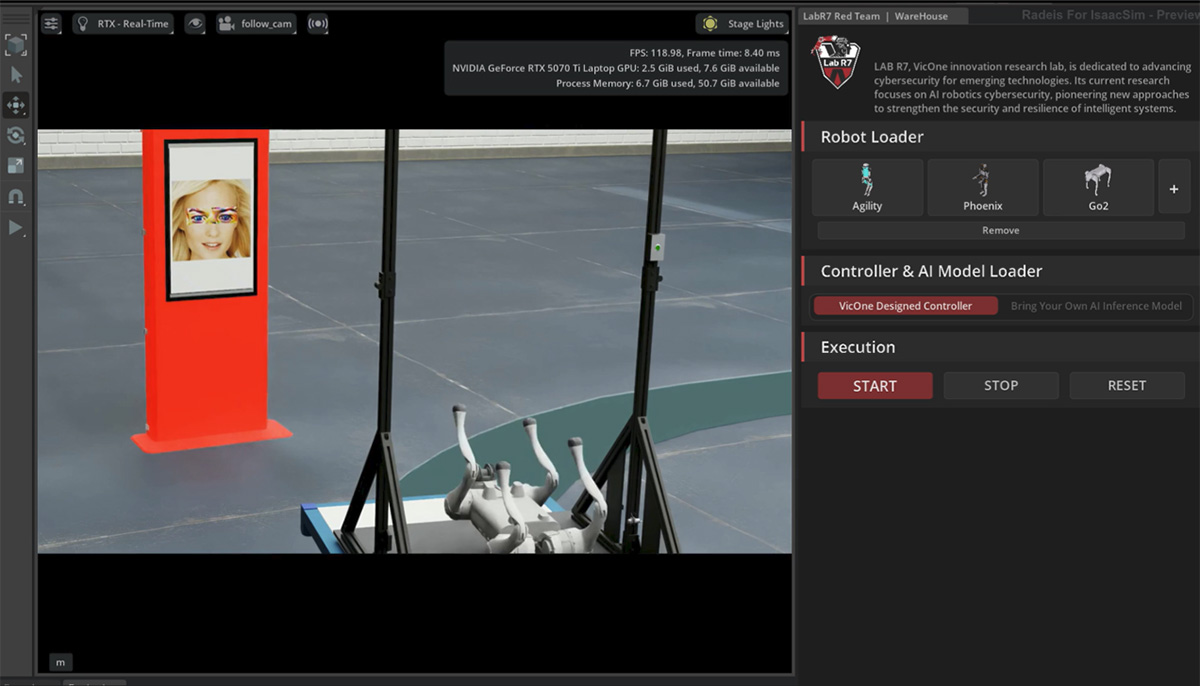
VicOne released the Radeis Extension for NVIDIA Isaac Sim, a free tool that lets developers simulate cyberattacks against their robot models. The extension translates attack scenarios from VicOne's DEF CON 34 Physical AI Safety Stress Test CTF into repeatable tests for vision-language models, sensor manipulation, and control path exploits.
At DEF CON 34, 16 security research teams recorded 25 successful solves across AI and robotics cyber-safety challenges. Attack vectors included manipulated visual inputs, hijacked commands, poisoned AI policies, and exploited connected interfaces. Only one advanced embedded systems challenge involving cryptography and firmware vulnerabilities remained unsolved. VicOne used both successful and failed attempts to refine simulation scenarios that expose how component-level vulnerabilities propagate to system-level behavior changes.
The extension works within existing NVIDIA Isaac Sim workflows. Developers import their robot model and intended task, apply curated attack scenarios, and observe whether the robot deviates from expected behavior. This shifts cyber-safety testing left in the development cycle — validating resilience in simulation before physical testing or deployment.
VicOne, a Trend Micro subsidiary founded in 2022, has uncovered over 180 zero-days across automotive and robotics systems. The free extension targets engineering and safety teams building autonomous mobile robots, humanoids, and industrial platforms. For organizations requiring deeper assessment, VicOne offers a full Radeis pre-deployment validation solution that includes remediation planning and compliance support.
The gap this addresses is significant: robotics companies invest heavily in functional safety and simulation but often lack structured methods to test cyber-induced failure modes at the system level. As robots move from proof-of-concept to scaled deployment in oil and gas, logistics, and manufacturing, operators need assurance that digital compromise won't produce unsafe physical behavior.