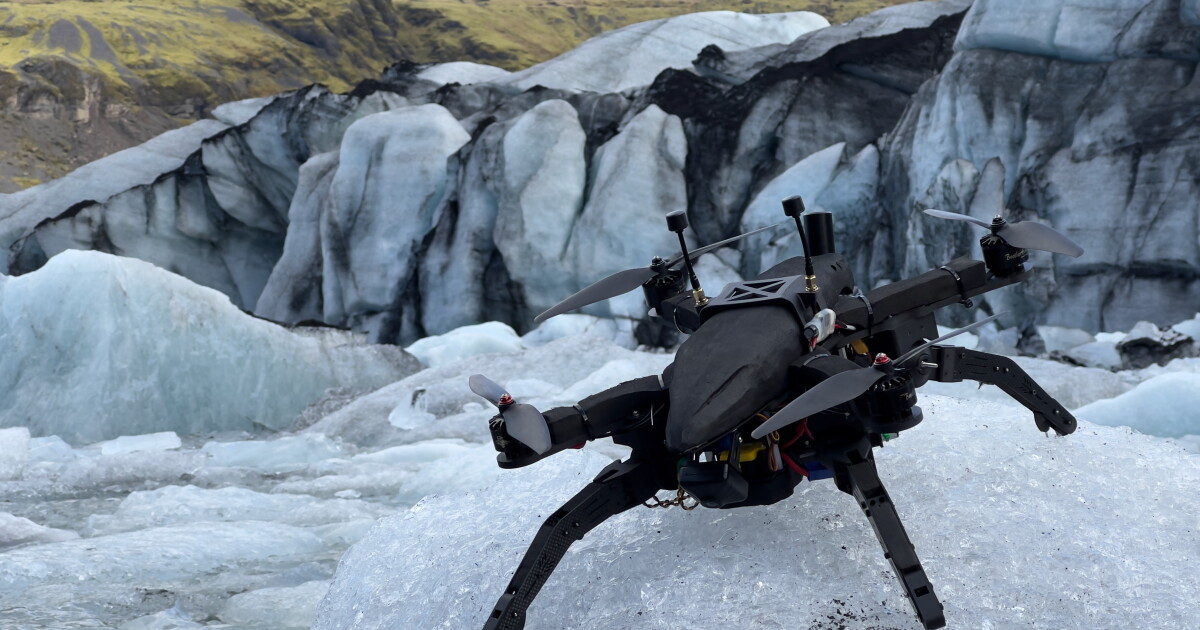
The Ice Dart quadcopter solved a longstanding problem in drone operations: conventional drones lose grip on ice at slopes as gentle as 9 degrees, making landing impossible in steep Arctic environments. The 2.65 kg aircraft uses spring-loaded spines in each foot that deploy passively on contact, combined with shock-absorbing landing gear and a brief reverse-thrust pulse that pushes the drone into the ice wall to ensure the claws bite.
Field trials in Iceland demonstrated 100% landing success on slopes up to 58 degrees in winds over 30 km/h and temperatures between 0–10°C. In lab conditions, the system handled 60-degree walls at landing speeds of 3 m/s. Once perched, the drone can shut down motors and high-power systems, extending mission time from minutes to hours or days while maintaining sensor operation.
The capability targets Arctic monitoring applications including iceberg tracking for maritime safety, offshore oil platform protection, and environmental research. Drifting icebergs pose direct threats to northern shipping routes and offshore infrastructure, but existing monitoring relies on expensive helicopter drops or ship deployments with limited coverage. A perched drone becomes a fixed sensor with near-zero energy draw and minimal acoustic, thermal, and RF signature.
The current system requires human piloting and has not yet been tested on a moving iceberg in open water. The research team at Université de Sherbrooke is working toward autonomous landing and deployment on genuinely drifting ice — the scenario where the technology would deliver maximum operational value.