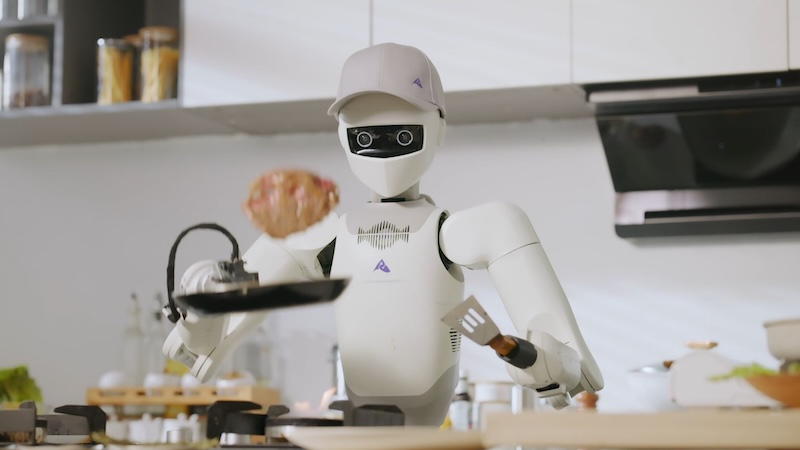
Astribot, a Shenzhen-based startup, debuted its T1 humanoid at IROS 2026 in Pittsburgh—the platform's first North American appearance. The robot is now available to US customers starting at $18,000 with immediate delivery. T1 stands 1.55 meters tall, weighs 66 kg, features 23 degrees of freedom, and supports 5 kg payload per arm.
The company positions T1 as an integrated Physical AI stack, not just a robot with AI layered on. Its Lumo-2 model handles reasoning-action tasks like autonomous tidying and manipulation of deformable objects. The embodied OS provides SDK/API access for joint control, Cartesian motion, and whole-body coordination, plus a natural language interface that generates robot applications from single-line prompts. At Astribot's recent Beijing hackathon, 15 teams built 10+ functional applications in 36 hours.
T1 uses a cable-driven architecture designed for dexterity, compliance, and high-speed movement. Astribot claims this design exposes richer physical interaction data to the AI stack compared to traditional actuator platforms. The system is modular—customers can swap end effectors, compute modules, and sensors for different tasks. Battery quick-swap and automatic charging are supported.
The platform does not learn autonomously during deployment. Instead, Astribot collects multimodal data from robot operation and teleoperation, retrains models offline, and pushes updates via OTA or on-site calibration. This is presented as a deliberate "learning by doing" approach rather than real-time adaptation. The $18,000 entry price puts T1 below most enterprise humanoid platforms, but buyers should assess what portion of marketed capabilities are production-ready versus dependent on future training.