Topic
Breakthrough
7 articles tagged with this topic
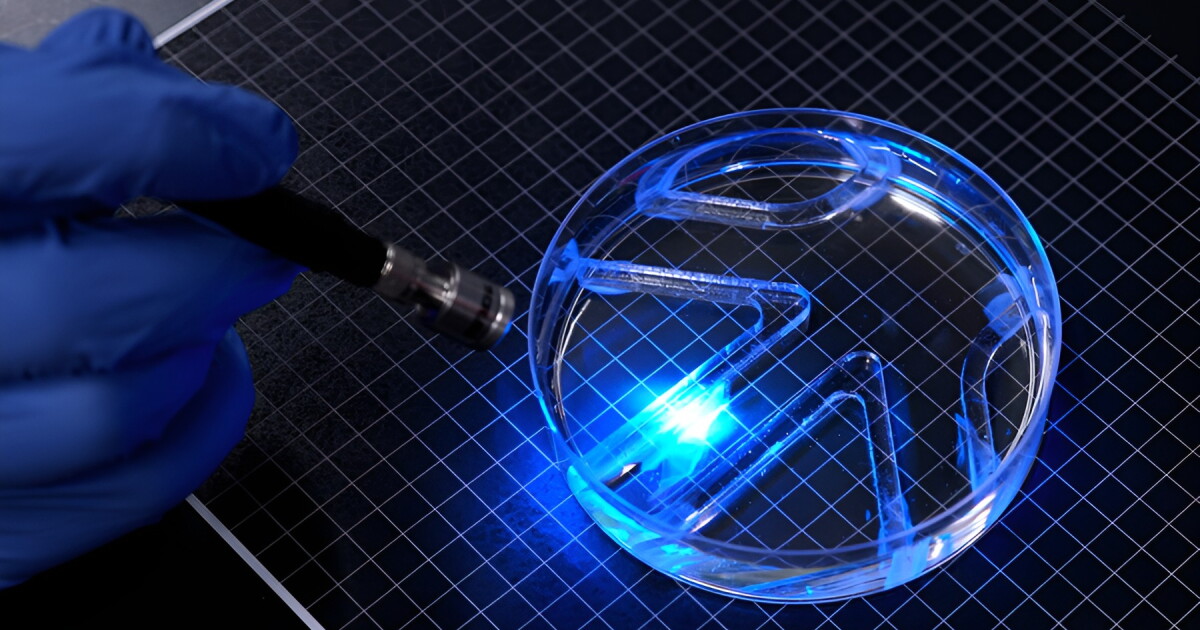
MIT robot swims using living muscle cells controlled by light
MIT researchers built a chewing gum-sized robot powered by a single layer of living muscle cells that contracts when exposed to light. The thin construction uses fewer cells than competing biohybrid designs and demonstrates basic navigation through a water maze, though it remains lab-bound and requires external steering.
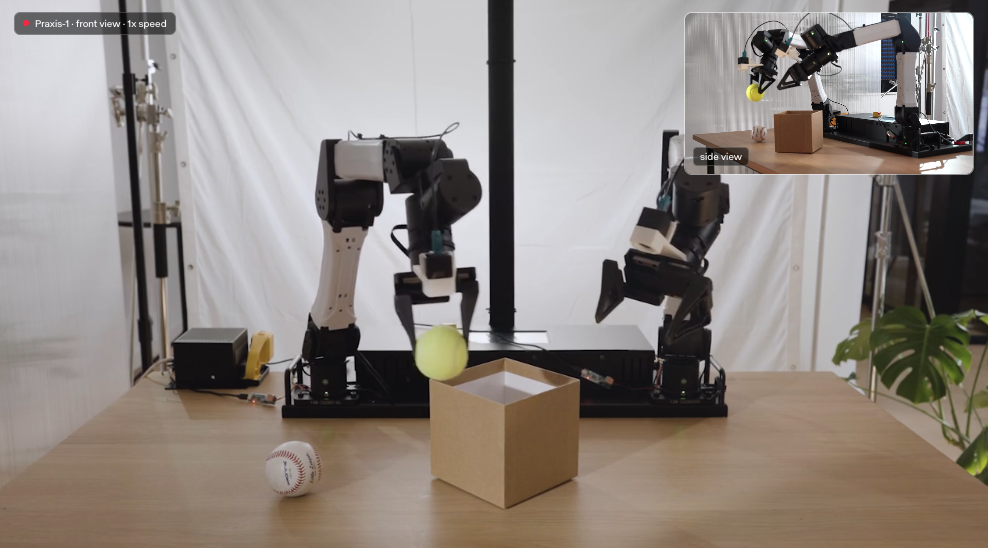
Runway releases Praxis-1, open-weight robot policy trained on web video
Runway has announced Praxis-1, an open-weight AI model that uses knowledge learned from ordinary web video to control physical robots. Early tests with Noble Machines, Standard Bots, and Ultra Robotics show robot policies pretrained on web video perform comparably to those trained on expensive teleoperated robot footage — a 16.1 cm placement error versus 16.0 cm. The move signals a shift in robotics training: instead of collecting massive robot-specific datasets, foundation models can transfer world knowledge from video at scale.
Skild AI unveils S1 foundation model with in-context robot learning
Skild AI has released S1, a robot foundation model that uses in-context learning to teach robots new tasks from single video demonstrations. The approach trains on four data types — teleoperation, human videos, simulation, and data-capture gloves — to enable generalization across form factors and complex, long-horizon tasks up to 10 minutes.
Autonomous vehicles learn to take passenger requests via LLM interface
Researchers at TU Delft have developed a system that uses an LLM to translate passenger requests like "go faster, I'm late" into parameter adjustments for a self-driving car's motion planner. The approach keeps the AI away from direct vehicle control, instead tuning criteria like speed and smoothness while requiring human confirmation before making changes — offering personalization without compromising the safety guarantees of deterministic planning algorithms.

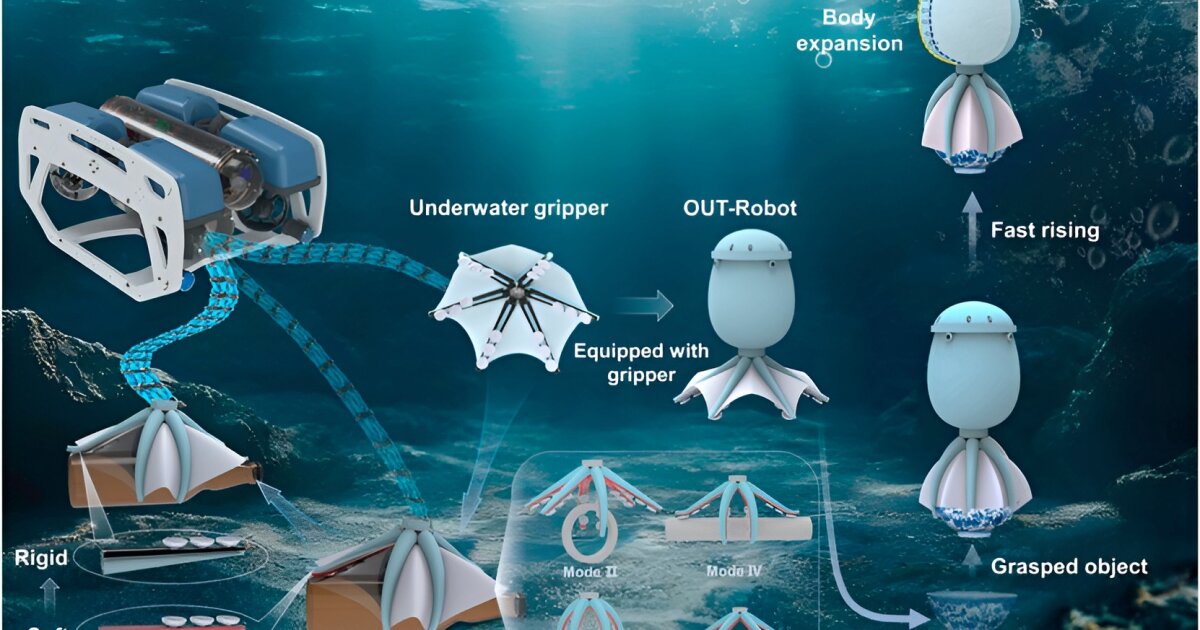
Octopus-inspired gripper shifts from soft to rigid in under 2 seconds
Researchers at Peking University have developed an octopus-inspired underwater gripper that transitions between soft and rigid states in 1.3 seconds — 10x faster than existing shape memory polymer systems. The OUT-Robot uses electrically heated PLA arms that grip fragile or irregular objects when soft, then lock rigid for zero-energy vertical lift via buoyancy control, carrying payloads over 500 grams.
Physical Intelligence releases π0.7 robotics foundation model
Physical Intelligence has released π0.7, a vision-language-action model that performs dexterous manipulation tasks across different robot platforms and can combine learned skills to solve new problems. The model uses multimodal prompts—language, visual subgoals, and metadata—to integrate diverse training data and achieve what the company describes as compositional generalization, including operating kitchen appliances and cross-embodiment transfer to robots with no task-specific training data.

Physical Intelligence trains robots to master precision tasks in 15 minutes
Physical Intelligence has developed RL tokens (RLT), a reinforcement learning method that allows vision-language-action models to refine precise manipulation skills using just 15 minutes of real-world robot experience. The technique adds a compressed "RL token" output to the base model, enabling a lightweight policy to train in real time without retraining the full VLA. Across four tasks—driving screws, fastening zip ties, and inserting cables—RLT improved execution speed up to 3× and outpaced human teleoperation.
